
← All articles
Production & budgets
How Much Does a 30-Second Commercial Cost in 2026? Real Prices Explained
By VydioAds · · 15 min read
Production & budgets
By VydioAds · · 15 min read
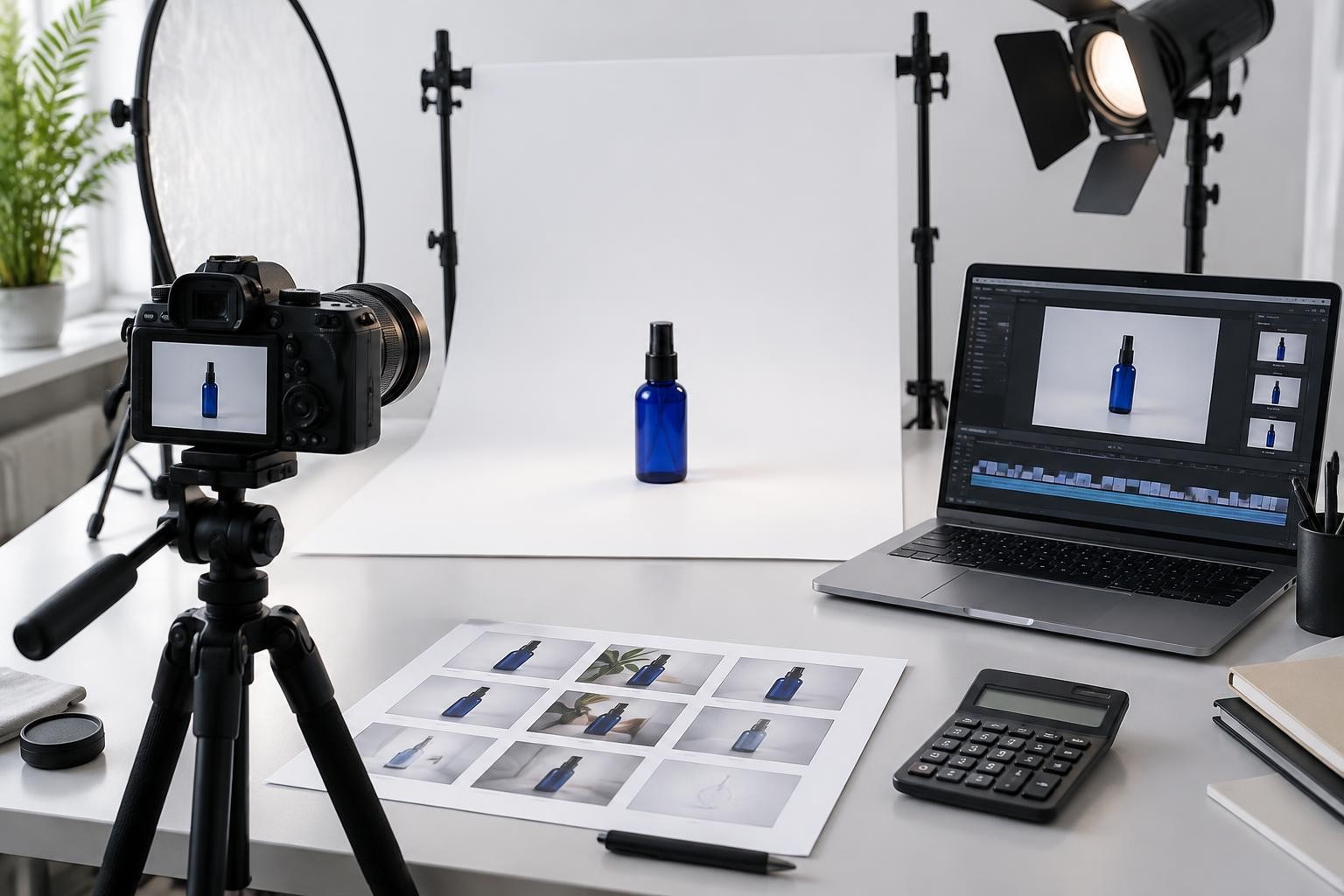
A detailed guide to 30-second commercial costs in 2026: fixed-price digital ads, professional shoots, broadcast production, airtime, usage rights and realistic campaign budgets—with clearly labeled prices and sources.
A 30-second commercial has two separate costs: making the video and paying to show it. In 2026, VydioAds lists one custom 15–30-second digital video ad at $49, using suitable existing assets within a limited scope. Production Soup's September 2026 guide describes $1,500 basic social spots through $150,000-plus broadcast campaigns for broader 30–60-second production; these are that provider's estimates, not a verified industry average or a quote for your project. Filming, talent, animation, usage rights and delivery requirements change the price substantially. TV airtime, streaming inventory and social or YouTube advertising budgets are separate and must be quoted or set for your audience, market and campaign.
Thirty seconds can mean a simple product edit built from photographs you already own, a founder filmed in one room, or a national television spot with actors, locations and visual effects. Those are not versions of the same purchase. They are different production models that happen to deliver a video of the same length.
The most useful answer to 'How much does a 30-second commercial cost?' is therefore not one impressive-looking average. It is a breakdown of what you are buying, what is excluded and what the campaign will cost after production. This guide explains each part so a small business can compare a $49 creative package with a filmed production quote without confusing either with the price of television airtime.
Editorial scope: published October 15, 2026. Prices are in US dollars unless otherwise stated. VydioAds publishes this guide and sells the packages below. Our own listed prices are identifiable service offers; external production ranges are attributed provider estimates, not independently audited market statistics. Budget examples are hypothetical planning exercises, not customer invoices or performance results. Rates, taxes, inventory and specifications can change. Request a current written quote for your actual brief.
Before comparing prices, write down the destination, the audience, the offer and the assets available. A 30-second social ad and a 30-second broadcast commercial need different production and delivery decisions.
A digital-first ad is typically designed for a phone feed or YouTube placement. It can use existing product photographs, website imagery, screen recordings, supplied clips, typography and motion design. Its job might be to explain one benefit and ask the viewer to visit a product page. It does not automatically need a cast, a location or a new shoot.
A filmed commercial adds original footage: people demonstrating a product, a real business location, a founder explaining an offer, or a scripted scene. That means production planning, cameras, lighting, sound and often talent permissions. The cost follows those requirements more than the final running time.
A broadcast or connected-TV commercial may require a landscape master, particular audio and file specifications, technical quality checks and delivery through approved channels. Thirty seconds alone does not establish broadcast suitability. Tell the producer where you intend to run it before they quote.
Treat a published package price, a provider's market estimate and a personalized production quote as three different kinds of evidence.
Published fixed-price offer: VydioAds Starter is listed at $49 one-time for one custom 15–30-second video ad, one format, one revision, script and captions, and a platform-ready file. This is creative production within that scope—not a promise of filming, actors, media buying, multiple formats or broadcast clearance.
Attributed production estimate: Production Soup's September 21, 2026 guide describes a range from $1,500 basic social-first spots to $150,000-plus national broadcast campaigns for professionally produced 30–60-second commercials. That range describes substantially broader work, and comes from a provider's editorial guide. It is not a universal rate card, an independently measured 2026 average or a like-for-like alternative to an existing-assets edit.
Written quote: only a quote based on your approved brief can establish the price of your shoot, talent, animation and usage. Check whether it includes creative development, production, post-production, rights, revisions, delivery and tax. An estimate that leaves half those items unspecified is not a final budget.
These numbers show why the market spans such different prices; they do not prove that all inexpensive work is poor or that all expensive work is effective. Buy the production model your campaign actually requires.
A second published reference helps explain the difference between a small creative order and an enterprise production engagement.
Shootsta's US production guide, published June 2026 and marked updated October 2026, describes $2,500–$8,000 per finished video on a subscription model and $6,000–$25,000-plus for one-off enterprise projects. Those are Shootsta's stated broader corporate-video ranges. They are not specific prices for every 30-second commercial and should not be presented as such.
An enterprise project can include multiple stakeholders, coordinated shoot days, brand approvals, regional versions and extensive project management. A short final edit can still require all of that infrastructure. Conversely, an existing-assets ad can avoid many of those expenses without pretending to offer the same production scope.
When comparing providers, ask for the deliverables rather than asking them all to match a headline price. A shoot-led quote and an editing-led package answer different needs.
Shootsta: Video production cost in the US, 2026 (enterprise scope and provider-published ranges)
Total campaign budget = creative production + rights and agreed extras + media distribution + measurement and management + applicable taxes and contingency.
Creative production pays for the file. Media distribution pays for access to viewers. Buying a commercial does not automatically put it on TV, TikTok, Instagram, Facebook or YouTube. Uploading it as an organic post also does not guarantee reach.
Rights and extras can include additional music licensing, performer usage, extra versions, translation, captions in other languages, stock assets and revisions beyond the agreed scope. Management may include campaign setup, optimization or reporting. Keep each item separate so you can see what the producer handles and what your team must arrange.
For a small campaign, protect a meaningful amount of budget for distribution and learning rather than spending everything on a single polished file. For a high-stakes shoot, protect the necessary production budget rather than hoping an inexpensive edit will replace footage you do not have.
Duration is only one variable. Complexity, people, permissions and approvals usually explain more of the difference between quotes.
Creative development: research, concept options, scripting, storyboarding and stakeholder review. A precise brief reduces wasted exploration. Several competing concepts require more work than one agreed concept, even if you ultimately choose only one.
Shoot requirements: crew size, equipment, travel, location access, permits, set styling, product preparation, makeup and sound recording. A single controlled product setup is different from an outdoor scene with a cast and weather dependencies.
Post-production: editing, motion graphics, color finishing, sound design, voiceover, visual effects and exports. Simple text animation is not equivalent to custom 3D product rendering. Ask what 'animation included' actually covers.
Approval and delivery: legal review, regional sign-off, versions, technical checks and rush schedules. An urgent delivery can change staffing and pricing. Obtain a revised quote when the brief changes rather than assuming every new requirement is included.
Paying for someone's performance is not always the same as buying unlimited rights to use that performance in advertisements.
A talent agreement should state the media, territory, duration and any exclusivity. Paid social use for a limited period, national TV use and perpetual worldwide use are different rights. A creator's organic post permission also may not cover paid advertising from their account or yours.
Ask whether your quote includes session fees, usage fees, renewals, agency fees and any applicable union obligations. Do not use a generic internet day rate as a substitute for the actual performer agreement. Voiceover has similar distinctions: a recording fee can be separate from the license to run it commercially.
For customer testimonials, keep documented permission and use genuine statements. Never invent a customer review, impersonate an endorsement or use an AI-generated face to imply a real person achieved results. If a material relationship needs disclosure, include it clearly in the creative.
A cheap asset becomes expensive if you cannot legally use it in the campaign you planned.
Check that music and stock licenses cover advertising, the intended platform, the territory and the relevant term. A popular sound available inside a personal account does not by itself establish paid-ad permission. Keep receipts and the applicable license terms with the project files.
Existing assets can lower the production bill, but they still need to be suitable for commercial use. Images taken from another company's website, footage copied from a social account and customer photos without permission are not a safe production shortcut.
AI tools may help with exploration or editing, but they do not remove the need to substantiate claims, respect likeness rights and inspect output. Review commercial-use terms, recognizable trademarks, unrealistic product behavior and category-specific restrictions. The relevant question is not merely whether a tool can generate a clip; it is whether that clip is accurate and usable.
There is no single nationwide price for a 30-second TV slot. Ask for a current media plan with the market, channel, program, daypart, dates and number of spots specified.
Local television, regional cable, national networks and major live events sell different audiences and inventory. Pricing can vary with geography, demand, timing, expected audience and negotiated packages. A widely quoted sporting-event price is not a useful estimate for a local retailer.
Ask whether the quote is per spot, per package, per thousand impressions or another buying unit. Also ask about production charges, placement fees, delivery, pre-emption or makegood terms, minimum commitments and cancellation rules. A low per-spot price without an audience estimate tells you little about value.
You should receive a schedule, audience assumptions and a total spend—not merely a claim that television is cheap or expensive. This guide intentionally does not present a national airtime average or unsupported 2026 event price. Your market-specific proposal is the relevant evidence.
Streaming campaigns may be bought around targeted impressions and a total budget rather than one fixed broadcast slot. Check the specific platform and buying arrangement.
Connected TV is not one marketplace with one rate. Inventory source, audience targeting, geography, seasonality, frequency and buying method affect what you pay. Ask about minimum budgets, service fees, measurement limitations, placement controls and the definition of a completed view.
For a hypothetical CPM of $25 and a hypothetical purchase of 40,000 impressions, the media calculation is 40,000 ÷ 1,000 × $25 = $1,000 before additional fees. This is an arithmetic example, not a quoted streaming rate or a promise that $1,000 will buy that inventory.
Do not equate impressions with unique people or customers. Frequency can mean one viewer sees the same ad several times. Agree how reach, website visits and conversions will be reported before placing the order.
For YouTube, TikTok, Instagram and Facebook, set a media budget separately from the production order. Auction costs and billing depend on your campaign configuration.
Google explains that, for most campaigns, its daily spending limit can be twice the average daily budget and its monthly spending limit is 30.4 times that budget. A constant $10 average daily budget therefore corresponds to a $304 monthly spending limit for those campaigns—not a hard $10 bill every day. Check the exceptions and your campaign settings before committing spend.
On social platforms, inspect the daily or lifetime budget rules inside your own account. Do not borrow a supposed average cost per click or view from an unrelated market and treat it as a sales forecast. Competition, creative quality, audience, offer and objective can all change the outcome.
Select a budget you can afford to test without depending on immediate profitable results. Define what counts as success, ensure the destination page works and check that conversion reporting matches actual customer activity. A professionally produced commercial is not a guarantee of sales.
Google Ads Help: About average daily budgets and spending limits
No. Start with the placement requirements and the message, not a compulsory duration.
TikTok, Instagram Reels, Facebook Reels and YouTube Shorts generally call for vertical creative. Standard YouTube player placements often need a landscape version. A single video should not be assumed to cover every destination just because its running time is 30 seconds.
Google's video-format documentation separates skippable in-stream, non-skippable in-stream, in-feed, bumper, Masthead and Shorts ads. Their rules and campaign availability differ. Confirm the current duration and file specifications for the actual placement rather than assuming all non-skippable inventory accepts your file.
Budget for adaptations explicitly: vertical, square or landscape; a shorter cut; captions; different opening hooks; translated text. Reframing a product and repositioning captions is editorial work, not always a one-click export. VydioAds Starter includes one format, so choose it deliberately.
Google Ads Help: Video ad formats and placement requirements
The following examples are invented planning scenarios with explicit assumptions. They are not verified invoices, market benchmarks or expected customer results.
Example A—existing-assets digital test: $49 Starter production + a hypothetical $300 media allowance + a hypothetical $51 reserve = $400 planned budget before any applicable taxes or extras. The reserve is not a quoted fee. This assumes you already have suitable assets, need one format and manage the campaign yourself. It does not include new filming.
Example B—small filmed production: assume $600 for planning, $1,800 for a controlled shoot, $900 for editing, $300 for agreed audio or asset rights and $400 contingency. Production totals $4,000. Adding a hypothetical $1,000 media allowance gives $5,000. Every line is a planning assumption to replace with supplier quotes; no crew or license provider is being offered at those rates.
Example C—creative testing pack: $179 Growth production + a hypothetical $600 media allowance + a hypothetical $121 reserve = $900 planned budget before tax or extras. Growth provides five ads under its listed scope. Five versions can support testing different messages, but dividing spend too thinly can leave every test inconclusive. Choose the test design with your campaign manager.
The purpose of these examples is to show the complete equation. A $49 production purchase is not a $49 paid campaign, and a $4,000 shoot is not automatically a $4,000 media launch.
Reduce avoidable complexity before cutting the parts that make the message understandable.
Choose one audience, one offer and one primary action. Supply your current logo, accurate product information, clean photographs, available footage and the intended landing page. An editor cannot create believable product detail from low-resolution scraps or replace a missing offer with expensive transitions.
Use existing assets when the product can be explained honestly that way. If live demonstration is essential, plan a focused shoot rather than an elaborate story with several locations. Record sound carefully and allow for captions. Viewers need to understand the benefit; they do not need a different cinematic technique every second.
Approve the script before production, consolidate feedback into one set of notes and choose the required formats up front. Make it clear who has final approval. A low initial quote can become a high final bill when several stakeholders repeatedly change the premise.
An existing-assets package is not a universal replacement for professional filming or a full production team.
Spend more when the purchase decision depends on seeing the product operate, a credible person demonstrate it or a real location inspire confidence. High-detail product work, complex animation, specialist industries, multiple languages and broadcast delivery can all justify a broader scope.
A large paid campaign also increases the cost of getting the message wrong. More budget for research, testing, legal review or technical quality assurance can be sensible when the exposure is substantial. Spend should solve a specific risk—not merely signal that the business is serious.
Conversely, an early-stage business testing an unproven offer may learn more from a few focused concepts than from one expensive brand film. Match investment to the decision you need the campaign to inform.
Get the scope in writing so you can compare equivalent deliverables and avoid surprises.
Deliverables: how many distinct ads, what running times, which aspect ratios, what resolutions and which caption or language versions? Are different hooks separate concepts or small edits? Are source files included or only finished exports?
Production and rights: is original filming included; who supplies the product and assets; what are the music, talent and stock rights; what happens when usage expires? Are permissions your responsibility or the producer's?
Process and price: what is due upfront, how many revision rounds are included, what counts as a scope change, what is the first-draft schedule, and which taxes or fees are excluded? Ask how cancellation, refunds and missed approvals are handled under the applicable terms.
Distribution: who uploads the video, buys media, checks specifications and measures results? If you need TV or streaming delivery, ask for that explicitly. Never assume 'commercial' means the same technical deliverable to every supplier.
The lowest production price is not automatically the lowest customer acquisition cost, and a large production bill does not guarantee profitable advertising.
For an illustrative evaluation, suppose $900 in creative and media spend is associated with 15 verified new customers. The arithmetic is $60 per new customer. That is not a prediction, and attribution still needs scrutiny: returns, existing customers, duplicated conversions and other marketing touchpoints can distort the result.
Compare that cost with the contribution you actually retain after product cost, fulfillment, payment fees and support. Revenue alone does not establish profit. For lead generation, measure qualified leads and eventual sales rather than celebrating every form submission.
Use creative diagnostics to decide what to change: whether the opening earns attention, whether the offer is understood and whether the destination page persuades. Do not replace a weak offer with a more expensive shoot simply because the first campaign underperformed.
Truthful, supportable claims and appropriate permissions are part of producing a usable commercial, not optional finishing touches.
The FTC's advertising guidance requires claims to be truthful, not deceptive or unfair, and evidence-based. Keep supporting evidence for performance statements, comparisons and pricing offers. Disclose meaningful limitations clearly instead of hiding them in unreadable text.
Categories such as health, finance and regulated services can require additional review. Platform approval is a separate question from legal compliance, and neither follows automatically from paying a producer. Build time for review into the schedule and discuss who is responsible for it.
Avoid fake urgency, invented reviews, misleading demonstrations and claims that an ad will deliver a guaranteed return. This guide is educational budgeting information, not individualized legal or financial advice.
Can you make a professional 30-second commercial for under $50? Yes, within a narrow existing-assets digital scope: VydioAds lists one custom 15–30-second ad at $49. That does not include a live-action shoot, television airtime or every format.
Does the $49 package guarantee exactly 30 seconds? The published scope is 15–30 seconds. State your preferred duration and destination in the brief; confirm any placement-critical requirement before ordering rather than assuming every ad should run the full 30 seconds.
How much is one local TV airing? Request a quote for your station, market, daypart and dates. A production package does not answer that question, and a national-event headline is not a local rate card.
Is animation cheaper than filming? Sometimes simple motion design using existing assets avoids shoot expenses. Detailed character animation or custom 3D can require substantial specialist work. Compare the actual concepts and deliverables, not the labels.
Do I need an agency? Not for every project. A fixed-scope production service can handle a focused creative order; a broader agency or production team may be appropriate for research, complex filming, media planning and ongoing management.
Can one ad run everywhere? Only if its formats, rights, duration and content satisfy each placement. Plan the adaptations, check the official specifications and do not assume one purchased format covers all screens.
Will a more expensive commercial convert better? There is no universal guarantee. Relevance, trust, offer quality, distribution and the landing page matter. Evaluate verified outcomes rather than treating production spend as proof of effectiveness.
If your goal is a focused digital ad built from assets you already have, start with VydioAds rather than paying for a production model you do not need. The highlighted Starter package below is the simplest way to order one ad.
Choose a package, enter your website and brand, select your platform and format, explain the offer and provide suitable assets through the online order process. You can then proceed to online payment. No account signup or sales call is required for the creative order; the order form collects the contact details needed for production.
Starter is $49 for one 15–30-second ad with one format, one revision, script and captions. Launch is $119 for three ads; Growth is $179 for five; Scale is $299 for ten; Pro is $499 for twenty. The Creative Subscription is listed at $799 per month for ongoing creative under its stated scope, not a fixed promised monthly video quantity. Use the package details and checkout for current terms.
Bring one clear campaign goal. We handle the creative production within the selected package; your business remains responsible for media spend, campaign management and the accuracy of its claims. Applicable taxes and agreed extras can change the total. Filming, broadcast clearance, additional rights and formats outside the package must not be assumed included.
Ready to turn the budget into a brief? Use 'Order one ad for $49' below to select Starter and begin the order process, or compare the full package range if you already need several concepts. If you are still planning, the newsletter signup in the footer offers another way to stay in touch without placing an order. No sales, advertising approval or return-on-spend guarantee is made.
VydioAds creates fixed-price video ads for brands, businesses and creators. Explore VydioAds, see our production process, or compare the packages below.
VydioAds · Starter
Send your website, available brand assets and campaign goal. We handle the script and creative production for one focused, platform-ready video.
Listed production price; applicable taxes and agreed extras may change the total. Platform ad spend and campaign management are separate. No sales or approval guarantee.
$49one-time
Listed turnaround: 3 business days.
VydioAds pricing
Fixed-price video ad packages start at $49. Select a package to send your brand and campaign goal online.
Starter
1 video ad
Delivered in 3 business days
Launch
3 video ads
Delivered in 4 business days
Growth
Most popular5 video ads
Delivered in 5 business days
Scale
10 video ads
Delivered in 6 business days
Pro
20 video ads
Delivered in 8 business days
Creative Subscription
MonthlyOngoing creative
Priority queue
The $49 Creative Test Drive
Put our scriptwriting, editing and motion design to work on one ad before you commit to more.
Need 25+ ads a month for variant testing?
Custom volume plans for brands and agencies running creative at scale.
Newsletter
Get new ad notes in your inbox.
One short, useful email when we publish a new article. No calls, no pitches.
Pick a package, send your brand, and get platform-ready video ads in days. No calls, no meetings.