
← All articles
Small business & creative testing
The $49 Video Ad Experiment: Can a Small Business Outperform a $5,000 Agency Commercial?
By VydioAds · · 15 min read
Small business & creative testing
By VydioAds · · 15 min read
Can a $49 video ad beat a $5,000 commercial? Learn how to compare creative fairly, measure qualified conversions and account for production costs—without confusing a cheaper invoice with better results.
A $49 video ad can outperform a $5,000 agency commercial on a specific small-business campaign, but price alone cannot predict the winner. Compare qualified purchases or leads under comparable audience, placement, offer, budget and attribution conditions. Separate production cost from media spend, then calculate both media-only cost per acquisition and total acquisition cost including creative. This article proposes a fair experiment; it does not report a completed head-to-head test or claim that VydioAds has beaten a $5,000 commercial. A low-cost ad is a smaller production commitment, not a guarantee of sales.
A beautifully lit commercial and a direct, product-first social video can do different jobs. One may establish a brand world; the other may answer the exact question stopping a customer from buying. When a small business asks which gets better results, the answer starts with the job—not the camera, the invoice or the production method.
The $49 versus $5,000 contrast is useful because it exposes a real budgeting decision: how much should you commit to producing creative before you know whether the message works? It becomes misleading when the price difference is presented as proof of a performance difference. An inexpensive video can be ineffective. An expensive production can be commercially valuable. Either can win a well-designed comparison.
This guide is for ecommerce owners, local service businesses and lean marketing teams evaluating paid video ads in 2026. It explains what the comparison can establish, how to design it, what to measure and how to decide the next step. You do not need to buy an expensive commercial to start testing a message; an existing authorized ad can be your baseline.
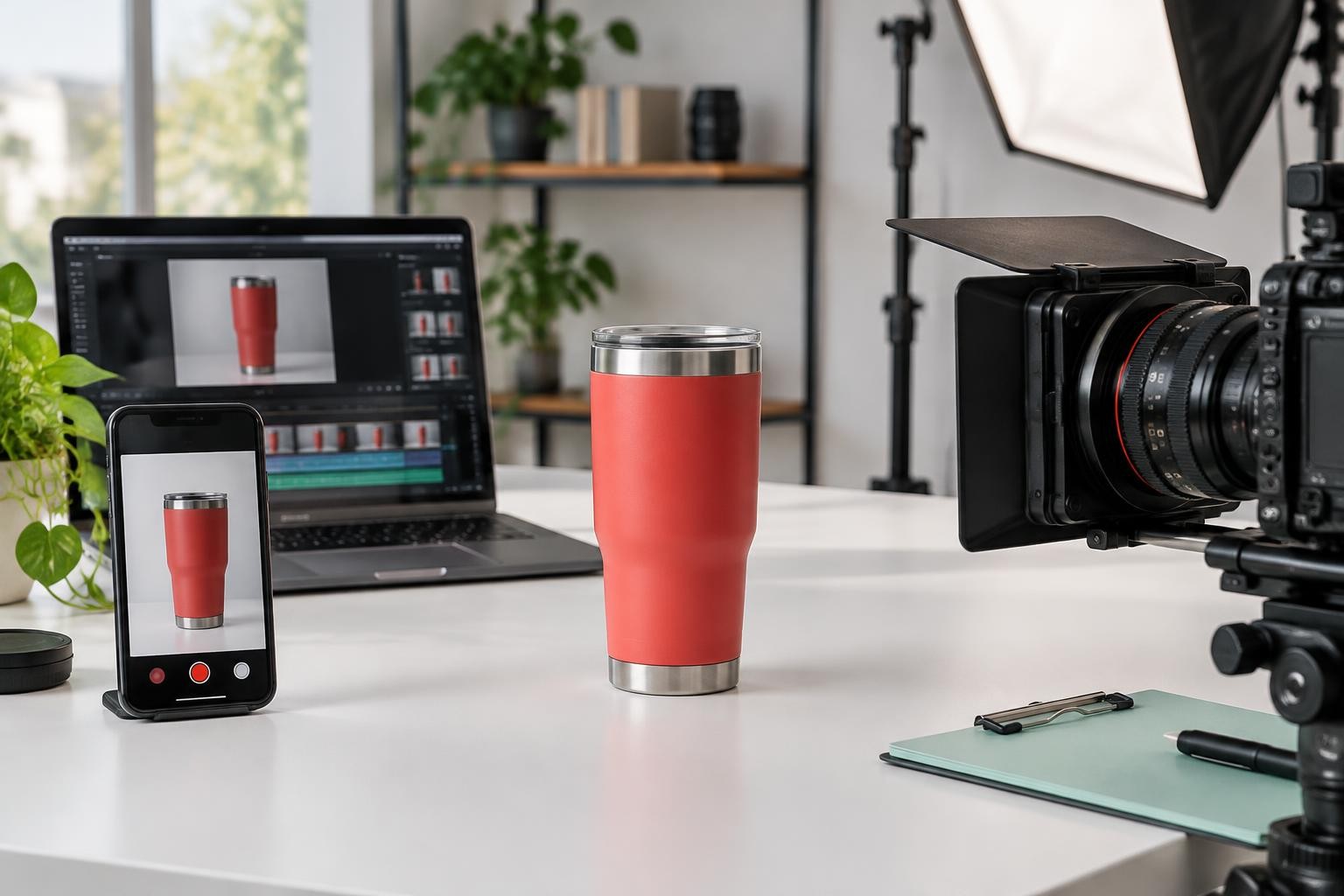
Editorial disclosure: published November 3, 2026 by VydioAds, which sells the Starter creative-production package discussed below. The $49 price is our current listed production price; $5,000 is a hypothetical comparison budget, not a verified agency quote or a market average. No live campaign experiment was conducted for this article. All numerical examples are invented planning illustrations, not customer results. The generated featured image illustrates two workflows. Official sources support measurement, creative and experiment principles—not a claim that our service outperforms an agency.
Yes, it is possible in a particular campaign. That possibility is not a universal performance rule and does not tell you which specific video will win.
People respond to a message in a context. A clear demonstration, recognizable problem, credible explanation and relevant next step can be more useful in a feed than an elaborate film that takes too long to reveal the product. Production quality matters when it helps the viewer understand and trust the offer; additional polish is not independently a conversion mechanism.
The reverse is just as plausible. A filmed commercial may show the real experience, people or technical detail that an asset-based edit cannot capture. Better casting, sound, lighting and direction may make the offer more convincing. When those elements resolve a real customer concern, their value goes beyond how impressive the video looks.
A valid conclusion is narrow: this creative performed better on this objective, for this audience, during this test. It is not evidence that every inexpensive ad beats every agency commercial, that AI always wins or that professional filming is obsolete.
Compare the scope before comparing results. A finished short-form ad and a custom production project are not automatically interchangeable services.
VydioAds Starter currently includes one custom 15–30 second video ad, one format, one revision, script and captions, and a platform-ready file. It is a one-time production purchase. Platform advertising spend, campaign management and performance measurement are separate. A full original shoot or a multi-channel campaign is not implied by this scope.
A custom quote might cover planning, filming, crew, editing, sound or licensing—but the deliverables depend on the actual proposal. Ask about original concepts, filming, talent releases, usage rights, revisions, formats and final files. Do not assume a $5,000 quote includes media buying or advertising spend, and do not treat that illustrative price as a standard agency rate.
Compare usable ads aimed at the same business action, while acknowledging differences in production scope. If the commercial also supplies photography, a brand film and multiple cutdowns, account for those assets separately. A broader package can create value the single-ad test never measures.
Pick one primary business outcome and write down what makes it valuable. Cheap views and attractive engagement are not substitutes for profitable customers.
For ecommerce, the primary outcome might be completed purchases, ideally with new-customer status and subsequent returns checked in store records. For a local service, it may be qualified enquiries or booked appointments. Decide how qualification works before the test: a form from outside your service area should not count as equally valuable to a relevant booking.
Use attention metrics as diagnostics. Early retention can reveal a slow opening; click-through rate can suggest interest; landing-page behavior can reveal a mismatch. None independently proves that the ad attracted customers worth acquiring. A video with fewer clicks can still be preferable when those clicks produce more suitable buyers.
Google's conversion guidance starts with choosing valuable customer actions to measure. The same discipline applies across platforms: confirm that the event represents the intended action, fires correctly and is consistent for both versions.
A useful test brief contains the comparison, primary metric, controlled conditions and decision rule. Write it before looking at results.
Example brief: We will compare our current authorized commercial with one new product-first short-form ad for the same product and offer. The primary metric is cost per qualified purchase, with refund behavior checked afterward. We will use a supported platform experiment where available, keep the destination and measurement consistent, set an affordable spending limit and evaluate after the planned observation period and normal conversion delay.
Choose whether you are comparing complete creative packages or isolating one creative element. A cinematic brand story against a direct product edit is a package comparison. The result may guide which file to use, but it cannot isolate whether the hook, music, presenter or production technique caused the difference.
If the specific question is about the opening, hold the rest of the ad steady and test openings. If the question is which finished ad best supports your current campaign, compare the complete ads and state that narrower interpretation.
Keep the experiment small enough to afford and structured enough to learn from. The process matters more than a dramatic price contrast.
Open the destination on a phone, confirm price and availability, complete the relevant form or checkout check, and verify conversion measurement. Fix broken steps before paying for traffic. Make sure both ads promise what the page actually provides.
Begin with the placement that fits your audience and business goal. Prepare each video for that same viewing environment. A vertical Reels edit and an unadapted landscape commercial create a format mismatch; reframe both appropriately before treating the comparison as informative.
Use the same product, price, discount eligibility and destination unless your stated experiment intentionally compares those variables. Different offers can overwhelm the creative difference. Keep required disclaimers accurate and readable in both versions.
Where the platform and account support it, use an experiment that controls audience allocation. Ordinary ad delivery is an optimization system, not a promise of equal or randomized exposure. Confirm which settings your chosen experiment holds constant.
Use your margins, typical conversion volume and time to purchase to plan the test. There is no universal budget or seven-day rule that makes every result reliable. Decide the maximum affordable loss and a planned review point; accuracy, stock or spending problems may justify stopping sooner.
Capture spend, qualified outcomes, cost per outcome, relevant attribution settings and conversion delay. Note website incidents, promotions and campaign edits. Reconcile reporting with store or booking records rather than relying solely on one dashboard total.
A useful experiment can end without a winner. Check volume, uncertainty and customer quality before expanding spend. Keep the result attached to its dates and conditions. Use what you learned to improve the next brief, not to make a permanent claim about production prices.
Use Meta's available A/B testing workflow when suitable, and understand what it controls. Giving two ads space in the same ad set is not equivalent to a controlled experiment.
Meta describes experiments that randomize and split audiences so that people in one test group do not see the other version. This can reduce overlap when comparing variations. Tool availability, objectives and account conditions can differ; review the setup before launch rather than assuming every campaign supports the same test.
If you simply upload two ads and let normal delivery optimize, one may receive more spend or a different mix of impressions. That can be useful operationally, but the observed difference is not a clean measurement of production quality. Report it as campaign delivery evidence, not a randomized head-to-head trial.
Maintain consistent attribution definitions and account for delayed purchases. Running one ad during a sale and the other after the sale, or comparing different audiences, can make the apparent winner a product of timing or targeting.
Google's video experiments can compare video creative using a selected success metric. Choose a metric aligned with the business question, not merely the easiest one to improve.
Google describes creative comparisons with the same audience and metrics that can include conversion rate or cost per conversion. Its basic experiment option tests creative as the single variable. Check eligible campaign types and the live setup instructions before planning your launch.
Review both videos for the viewing environment. Make branding, the relevant product and the desired action clear. A social cut may need adjustment for the chosen YouTube placement; do not assume one export is ideal everywhere.
Google's ABCD principles—Attention, Branding, Connection and Direction—provide a practical creative review framework. They can help evaluate both a lean edit and a filmed commercial. They are not a guarantee that a particular video will produce conversions or a substitute for measuring your own campaign.
Report two different cost views. The media-only view helps judge delivery efficiency; the total-cost view includes what you paid to create the ads.
Media-only cost per acquisition (CPA) equals advertising spend divided by the counted acquisitions. Total acquisition cost for this simplified comparison equals advertising spend plus allocated production cost, divided by those same acquisitions. Use qualified outcomes in both denominators. Neither calculation alone describes profit, incrementality or lifetime value.
If there are zero acquisitions, CPA is not a usable finite number. Report the spend and zero outcomes rather than disguising the result with a made-up cost. If one ad generates leads but not customers yet, label it cost per lead—not customer acquisition cost.
Choose a production-cost allocation that reflects actual use. Charging the full cost of a multi-use commercial to one short test can overstate that test's ongoing creative burden. Leaving the cost out entirely can understate the investment. Report full upfront cost and an explicitly justified allocation where broader reuse matters.
Invented arithmetic can explain the trade-off without pretending to be evidence. Here the expensive creative is more efficient at converting paid traffic, while the lower production commitment has a different total-cost profile.
Suppose each ad receives $600 in media spend. The $49 ad produces 15 qualified purchases: media-only CPA is $600 ÷ 15 = $40. Including its full production cost gives ($600 + $49) ÷ 15 = about $43.27 per purchase. The $5,000 commercial produces 20 qualified purchases: media-only CPA is $30. Including its full production cost gives ($600 + $5,000) ÷ 20 = $280 per purchase.
In this illustration, the commercial wins on media-only acquisition cost. The $49 ad has the lower acquisition cost when the entire production invoice is charged to this one short window. Both statements are true because they answer different questions. The figures do not establish statistical reliability and are not reported VydioAds results.
If the commercial keeps generating results across future campaigns, its allocated production cost per acquisition can fall. If it also supplies reusable brand assets, those uses may matter. Conversely, a cheap video that generates no suitable customers is not commercially successful merely because its invoice is small. Do not extrapolate a short example into a lifetime winner.
Revenue and profit are not interchangeable. Set an affordable acquisition limit using your business economics before you run the comparison.
For an illustrative first-order calculation, start with revenue after expected refunds and subtract product costs, fulfillment, payment fees and other relevant variable costs before advertising. The remaining contribution is the amount available for acquisition and overhead. This simplified framework is not a complete accounting model.
Do not assume future repeat purchases make a loss-making first order acceptable unless you have evidence and enough cash to support the payback period. For services, account for lead qualification, booking rate, capacity and the margin on completed work. A low form-completion cost can hide poor commercial value.
Compare both creatives against that practical limit as well as against each other. One can win the test while both remain unaffordable. A relative winner is not automatically a campaign worth scaling.
The opportunity is focus: one viewer, one customer problem, one supported promise and one next step. Low production cost can make an initial commitment smaller without making the thinking optional.
A concise product-first opening may immediately establish relevance. Real photos or authorized footage can clarify the item. Readable captions and a direct explanation can make the message understandable without audio. A clear call to action can connect the ad with the destination rather than leaving the viewer to infer what happens next.
A defined deliverable also encourages a bounded brief. Instead of trying to say everything about the business in one film, identify the question this creative should answer. That discipline can improve the test even if the first version loses.
Do not equate low cost with a specific production technology. Editing existing material, motion design, original phone footage and AI-assisted processes have different strengths. What matters is whether the final file accurately communicates the offer and fits the placement.
Invest more when the production solves a problem that a lean edit cannot solve, and when the likely use justifies the commitment.
Original filming can be important for a real customer demonstration, an authentic location, a founder explanation or a product that must be shown operating accurately. Specialized direction, sound and lighting can reduce ambiguity in these situations. A premium product experience may need more than an animated photograph to establish trust.
An agency engagement may also deliver strategy, several assets, coordination and usage rights across campaigns. Evaluate those responsibilities separately from the conversion rate of one cut. The right comparison is the work your business actually needs, not whichever invoice makes the strongest headline.
If you already have a suitable commercial, do not discard it because a cheaper option exists. Reuse it as an authorized baseline, create a purposeful challenger and let measured outcomes inform the next production decision.
Most misleading comparisons change more than the video or stop before enough useful evidence has accumulated.
Warm retargeting versus cold acquisition, a discounted offer versus full price, or a holiday promotion versus an ordinary week are not equivalent conditions. Identify those differences before attributing the result to the creative.
The correct framing may be doing much of the work. Adapt each ad to the same intended placement, preserve readable captions and preview the actual upload.
Low-volume differences can be unstable. Do not repeatedly stop whenever your preferred version looks ahead. Use the planned review criteria, allow for conversion delay and accept an inconclusive result.
Check service eligibility, purchase intent, bookings and completed work. Qualification matters when a creative attracts high volumes of unsuitable leads.
An ad can win attention and lose the sale on a slow page, unclear shipping cost or broken form. Check the shared customer journey before ordering endless replacements.
Neither a production budget nor an AI tool removes the obligation to advertise accurately. Evidence should come before claims, including claims about this experiment.
Use genuine authorized customer statements and disclose relevant material connections where required. Do not create a synthetic customer who appears to report a real experience, invent sales numbers or use a generated demonstration as proof of product performance. Make sure the depicted item matches what the buyer receives.
Review commercial-use permissions for footage, fonts, music, photographs and people. A tool subscription is not blanket permission to use every asset or likeness. Protect brand and product accuracy through the edit and final export.
The FTC's small-business guidance states that advertising must be truthful, non-deceptive and supported by evidence. If you later share test results publicly, identify the outcome, scope, dates and limitations. 'Beat a $5,000 commercial' is a performance claim—not a safe conclusion to invent from a hypothetical illustration.
Use the result to choose a next action, not to settle the entire debate about affordable ads versus agencies.
If the challenger performs well on qualified outcomes, consider a measured next step within your acquisition limit. Increased spend can change delivery conditions; the original test does not guarantee the same results at a larger scale. Keep a useful baseline and plan a meaningful next variation.
If the commercial performs better, identify what it communicates more effectively. The next brief might need stronger proof, a clearer opening or genuine demonstration footage. If both fail, inspect the offer, audience, tracking and destination instead of assuming more polish is the only solution.
If the result is inconclusive, keep the evidence and respect the budget limit. You may need a simpler question or more volume, but a small business is not obligated to spend beyond its means for statistical certainty. A disciplined no-winner result is more trustworthy than an exaggerated success story.
These answers summarize what the price comparison does—and does not—tell a small business.
No. This article proposes a test and uses explicitly hypothetical calculations. It does not report a completed VydioAds campaign experiment, an independent study or a guaranteed result.
Not necessarily. It is an illustrative comparison budget here. Actual quotes vary by crew, scope, filming, editing, rights and deliverables. Ask for an itemized proposal rather than treating one number as a market average.
No. Starter is a creative-production package. Media spend, campaign management and conversion measurement are separate. Applicable taxes and agreed extras can affect checkout totals.
One custom 15–30 second video ad, one format, one revision, a script and captions, and a platform-ready file. Check current package details before ordering. It does not guarantee sales, return on ad spend or platform approval.
There is no universal duration. Plan around affordable spend, conversion volume, normal conversion delay and a defined review point. A fixed number of days cannot make a low-volume test conclusive.
Choose the primary metric that fits the business objective. Qualified acquisition cost is useful for purchases or leads; revenue-based ROAS needs margin context. Views and retention help diagnose the creative but do not independently prove profitability.
No. Use an existing suitable ad you have permission to run, or begin by testing one focused message without a head-to-head production-budget comparison. Do not buy an expensive baseline just to recreate the headline.
Yes, when the finished ad is accurate, authorized and compliant with applicable rules. Label the comparison honestly: testing two complete creatives does not isolate AI as the cause of any difference.
Before launch, write down the product, audience, placement, unchanged offer, destination, primary qualified outcome, tracking setup, spending limit and planned review point.
Confirm that both ads are accurate, authorized and formatted for the same placement. State whether you are testing complete creative approaches or one variable. Record production cost separately from advertising spend and define any cost allocation. Decide how you will treat delayed conversions, refunds and unsuitable leads.
Afterward, record the dates, delivery conditions, qualified outcomes, media-only CPA and total-cost calculation. Note uncertainty and the limitations of the comparison. Choose the next step without pretending that a single campaign answers every business's creative question.
If your offer and destination are ready but you need a focused creative challenger, VydioAds Starter is a defined way to begin. The purpose is a usable ad—not a promise to beat an agency.
Share your website, suitable product or brand assets, intended platform and the question the ad should answer. The highlighted Starter offer below takes you to the existing online brief and payment flow. Its scope keeps the first purchase bounded; your campaign setup and test budget remain your separate decisions.
If you need several distinct concepts, compare the current packages rather than buying a batch without a plan. If you are still choosing the first message, subscribe to the video-ad notes below. Newsletter signup is free, separate from ordering and does not start a paid subscription.
The bottom line: a $49 ad can be a sensible experiment because it lowers the initial creative commitment. Whether it performs better than a particular commercial is an evidence question. Buy the work you need, run the fairest test you can afford and let qualified customer outcomes—not the headline—guide the next investment.
Newsletter
Get new ad notes in your inbox.
One short, useful email when we publish a new article. No calls, no pitches.
VydioAds creates fixed-price video ads for brands, businesses and creators. Explore VydioAds, see our production process, or compare the packages below.
VydioAds · Starter
Turn your product, offer and customer question into one focused video ad. Starter includes a custom 15–30 second ad, one format, a script, captions, one revision and a platform-ready file. Bring your website and suitable brand assets; use the finished creative as a challenger in your own campaign.
Listed production price; applicable taxes and agreed extras may change the total. Platform ad spend and campaign management are separate. No sales or approval guarantee.
$49one-time
Listed turnaround: 3 business days.
VydioAds pricing
Fixed-price video ad packages start at $49. Select a package to send your brand and campaign goal online.
Starter
1 video ad
Delivered in 3 business days
Launch
3 video ads
Delivered in 4 business days
Growth
Most popular5 video ads
Delivered in 5 business days
Scale
10 video ads
Delivered in 6 business days
Pro
20 video ads
Delivered in 8 business days
Creative Subscription
MonthlyOngoing creative
Priority queue
The $49 Creative Test Drive
Put our scriptwriting, editing and motion design to work on one ad before you commit to more.
Need 25+ ads a month for variant testing?
Custom volume plans for brands and agencies running creative at scale.
Pick a package, send your brand, and get platform-ready video ads in days. No calls, no meetings.