← All articles
Creative testing & strategy
Why Your $10,000 Meta Ads Budget Is Failing Because of the First 1.5 Seconds of Your Videos
By VydioAds · · 13 min read
Creative testing & strategy
By VydioAds · · 13 min read
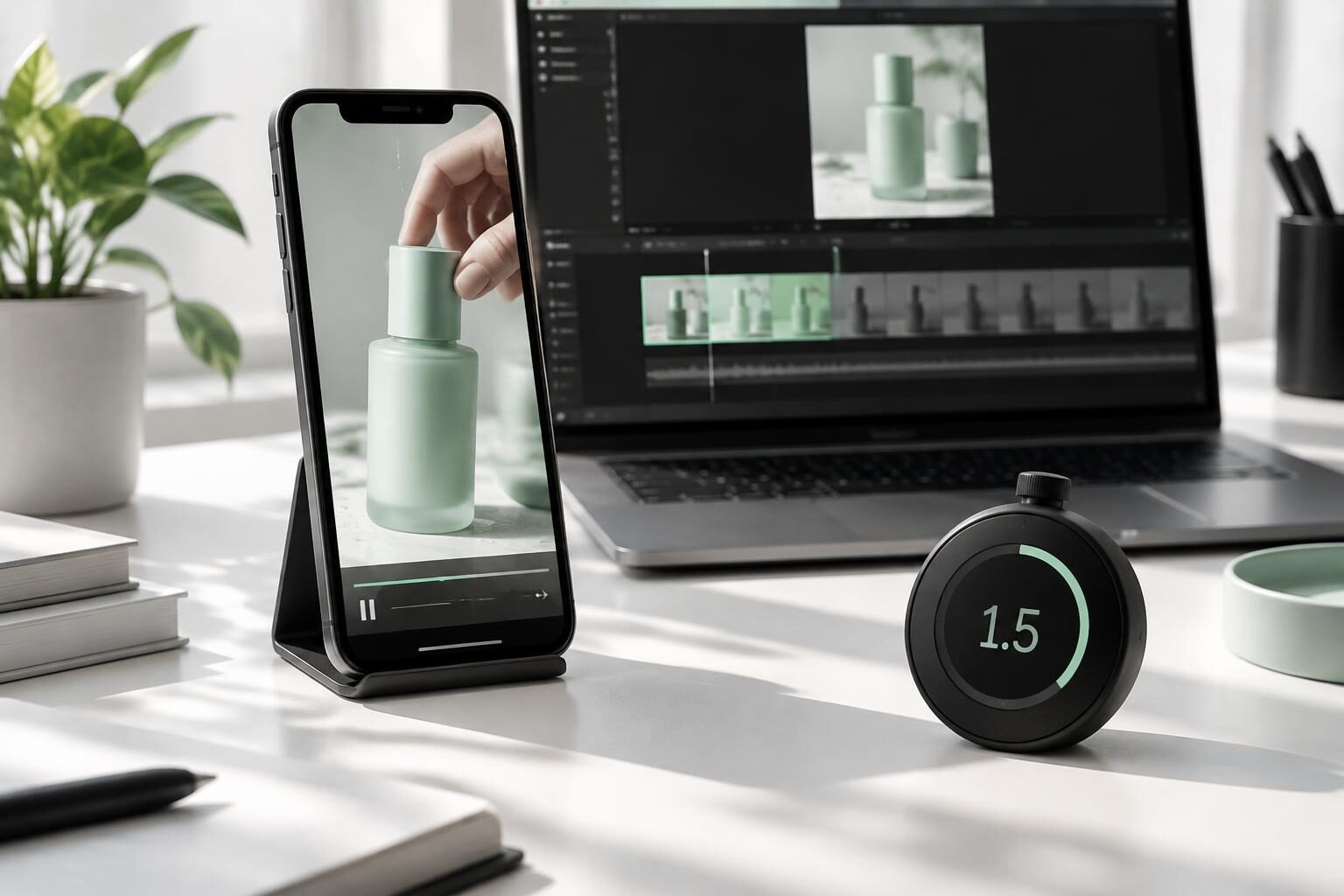
If your Facebook and Instagram video ads get impressions but few results, the opening may be the problem. Learn how to diagnose a weak first 1.5 seconds, rebuild the hook and test it fairly before spending more.
A $10,000 Meta ads budget can underperform when the first 1.5 seconds of a video fail to show viewers why they should keep watching. In a mobile feed, people decide very quickly whether to stop scrolling, so a slow logo intro, vague first frame or late product reveal can waste spend before your message begins. Fix it by opening with the product, problem or result immediately, adding captions for sound-off viewing, framing for the placement, and testing several openings against one consistent offer and conversion metric. The opening is not the only possible cause—check tracking, targeting, offer and landing page too—but it is one of the cheapest things to fix.
Most video ads are judged before they finish their first sentence. On Facebook and Instagram, your ad competes with friends, creators and every other brand in a fast-moving feed. If the opening frame looks like everything else—or like nothing at all—the viewer scrolls on and your carefully written middle section never gets a chance.
That is why a large budget can quietly fail. Meta can deliver thousands of impressions, but impressions only buy the chance to be seen. The opening decides whether that chance turns into attention, and attention is the precondition for every click, lead or purchase that follows.
This guide explains why the first moments matter, how to tell whether your opening is the problem, what a strong first 1.5 seconds contains, and how to test new hooks without wasting more money. It is written for small businesses and lean teams spending real money on Meta video ads in 2026.
Editorial disclosure: published November 4, 2026 by VydioAds, which sells the video-ad production packages mentioned below. The "$10,000" figure is an illustrative budget, not a customer case study, and "1.5 seconds" is a practical planning window rather than an official Meta threshold. Numerical examples are invented for planning. Linked Meta and TikTok sources support creative and measurement principles, not a claim about VydioAds results.
Because paid delivery buys a moment on screen, not attention. If the opening does not earn a pause, everything after it—your offer, proof and call to action—goes unseen.
Feeds are built for scrolling. A viewer's thumb is already moving when your ad appears, and the first frames are effectively a thumbnail that has to compete with everything around it. Meta's own creative guidance for mobile video consistently advises capturing attention quickly, putting the brand or product early and designing for sound off.
TikTok's Creative Codes make the same point for short-form video generally: the beginning of the ad has to hook the viewer, because that is where most people decide whether to keep watching. The principle carries across Reels, Stories and Feed.
We use 1.5 seconds as a practical editing window: roughly the first few frames to the first spoken phrase. It is not an official cutoff or a magic number. The lesson is simply that the job of the opening is to stop the scroll and make the next second feel worth watching.
There is no fixed percentage, but the logic is simple: every impression where a viewer scrolls past in the first second is spend that produced no consideration.
Hypothetical illustration: imagine $10,000 delivering a large number of impressions at a steady cost. If a slow opening means far fewer people watch past the first seconds, fewer people ever see the product, the offer or the call to action. You are still paying for delivery, but the funnel narrows at the very top.
A weak opening also affects what happens next. Fewer engaged viewers means fewer clicks and conversions for Meta's delivery system to learn from, which can make results feel unstable. Improving the opening can raise every downstream number without changing the budget at all.
This is an invented planning illustration, not a measured result. Your actual numbers depend on audience, offer, placement, competition and destination.
Look for strong delivery with weak early attention. That pattern points at the creative opening rather than at targeting or spending levels.
Compare 3-second video plays (or similar early-view metrics) against impressions. If very few impressions turn into early views while delivery is healthy, the opening is not stopping people. Use the reporting columns available in Ads Manager to check.
If the audience is right and the offer is competitive but click-through is low across placements, viewers may not be getting far enough into the video to understand it.
Watch your own ad muted on a phone. If you cannot tell what is being sold or why it matters within the first moment, neither can your audience.
A horizontal TV-style intro cropped into a vertical Reel often opens with empty space, small text or a logo. Placement-native framing matters from the first frame.
Before rebuilding the hook, confirm the problem is not tracking, offer or destination. A brilliant opening cannot fix a broken pixel or an uncompetitive price.
Check that conversion events fire correctly and that the attribution setting matches how you compare results. Confirm the landing page loads quickly on mobile and matches the promise in the ad. Make sure the offer itself is competitive and clearly priced.
Also check whether results dropped after a significant edit that sent the ad set back into the learning phase, or whether the same audience has simply seen the ad too often. Those problems look like creative failure but need different fixes.
A strong opening shows something specific, immediately, that the right viewer cares about. It needs no setup to understand.
Show the product in use, the outcome or the before-state right away. Skip logo animations, slow fades and establishing shots.
Name or show a specific frustration: 'Your coffee goes cold by 9am?' Specificity tells the right person this is for them.
A hand entering frame, a pour, a reveal or a sharp visual contrast draws the eye in a static feed. Avoid frantic cutting that makes the message unreadable.
Many people watch muted. A short, legible line of text in the safe area carries the hook even when the audio does not.
Fill a 9:16 or 4:5 frame for Reels, Stories and Feed. Keep key text and product inside the safe zones so interface elements do not cover them.
Use these as starting points for different hook variations of the same ad. Each should be truthful and match the rest of the video.
Open on a line or visual naming the exact pain point the product solves.
Show the finished outcome, then explain how to get it.
Start mid-action: the product working, in close-up.
Lead with a specific, substantiated benefit. Never invent figures or results.
Ask something the right viewer instantly answers 'yes' to.
Show the old way next to the new way in a single split frame.
Open with a genuine, permitted customer quote or reaction. Testimonials must reflect real experiences.
Change only the opening, keep everything else steady, and judge on your real business outcome.
Create three to five versions of the same ad that differ only in the first seconds. Keep the offer, middle, call to action, landing page and audience consistent so any difference can be attributed to the opening.
Use Meta's A/B testing tools where suitable, or a clean ad-set structure with comparable budgets. Avoid launching and pausing variants constantly; significant edits can reset learning and muddy results.
Judge winners on qualified purchases or leads, using early retention and click-through as diagnostics. A hook that gets many views but attracts the wrong buyers is not a winner. Allow enough spend and time for a meaningful comparison before deciding.
Most weak openings share a handful of habits that are easy to fix in editing.
Opening with a logo or brand intro. Starting with a talking head saying 'Hi, I'm…'. Relying on audio for the hook. Using tiny text or placing it under interface buttons. Cropping a horizontal video into vertical with black bars. Making the first frame a dark or blurry transition. Using a clickbait hook that the rest of the ad cannot honestly deliver.
Quick answers about video ad openings on Facebook and Instagram.
No. It is a practical editing window used in this guide. Meta's guidance emphasizes capturing attention quickly, but it does not set a single cutoff.
Showing your product or brand early can help recall, but a slow logo animation is usually a weak opener. Integrate branding into the first shot instead of making it a standalone intro.
Three to five is a practical batch for most small budgets: enough to compare, not so many that spend is spread too thin.
No. It improves the chance that viewers see your message. Offer, price, landing page, targeting and tracking still determine results.
Often the idea can, but framing and text placement should be adapted to each placement's shape and safe areas.
Strongly recommended. Many people watch with sound off, and captions also improve accessibility.
Usually not first. Diagnose the creative, offer and destination. Adding spend to a weak opening tends to buy more of the same scrolling.
Before you spend another dollar, watch the ad muted on a phone and confirm each point.
Product, problem or result visible in the first frame. A clear reason to keep watching. Readable on-screen text in the safe area. Native vertical or 4:5 framing. No logo intro, black bars or slow fade. Hook matches the offer honestly. Tracking verified. Several opening variants ready to test against one primary metric.
If your offer works but your ads are not stopping the scroll, the fastest fix is a batch of focused hooks. VydioAds Growth is built for exactly that.
Growth includes five custom video ads, so you can test different openings for the same offer instead of betting your budget on one. Each comes with a script, captions and platform-ready files. Ad spend and campaign management remain separate, and no package guarantees sales.
Want to start smaller? The $49 Starter gives you one focused ad to challenge your current opening. Or try the free hook generator to brainstorm ideas first.
Newsletter
Get new ad notes in your inbox.
One short, useful email when we publish a new article. No calls, no pitches.
VydioAds creates fixed-price video ads for brands, businesses and creators. Explore VydioAds, see our production process, or compare the packages below.
VydioAds · Growth
Growth gives you five custom video ads built to test different openings for the same offer—each with a script, captions and platform-ready files. Instead of pouring more budget into one weak first second, you get a structured batch of hooks to compare in your own Meta campaign.
Listed production price; applicable taxes and agreed extras may change the total. Platform ad spend and campaign management are separate. No sales or approval guarantee.
$179one-time
Listed turnaround: 5 business days.
VydioAds pricing
Fixed-price video ad packages start at $49. Select a package to send your brand and campaign goal online.
Starter
1 video ad
Delivered in 3 business days
Launch
3 video ads
Delivered in 4 business days
Growth
Most popular5 video ads
Delivered in 5 business days
Scale
10 video ads
Delivered in 6 business days
Pro
20 video ads
Delivered in 8 business days
Creative Subscription
MonthlyOngoing creative
Priority queue
The $49 Creative Test Drive
Put our scriptwriting, editing and motion design to work on one ad before you commit to more.
Need 25+ ads a month for variant testing?
Custom volume plans for brands and agencies running creative at scale.
Pick a package, send your brand, and get platform-ready video ads in days. No calls, no meetings.